Helpmaton Review - AI Agent Management Platform with Predictable Budget Control and Persistent Memory
AI Agent Governance: Why Unmanaged Agents Become Organizational Liabilities
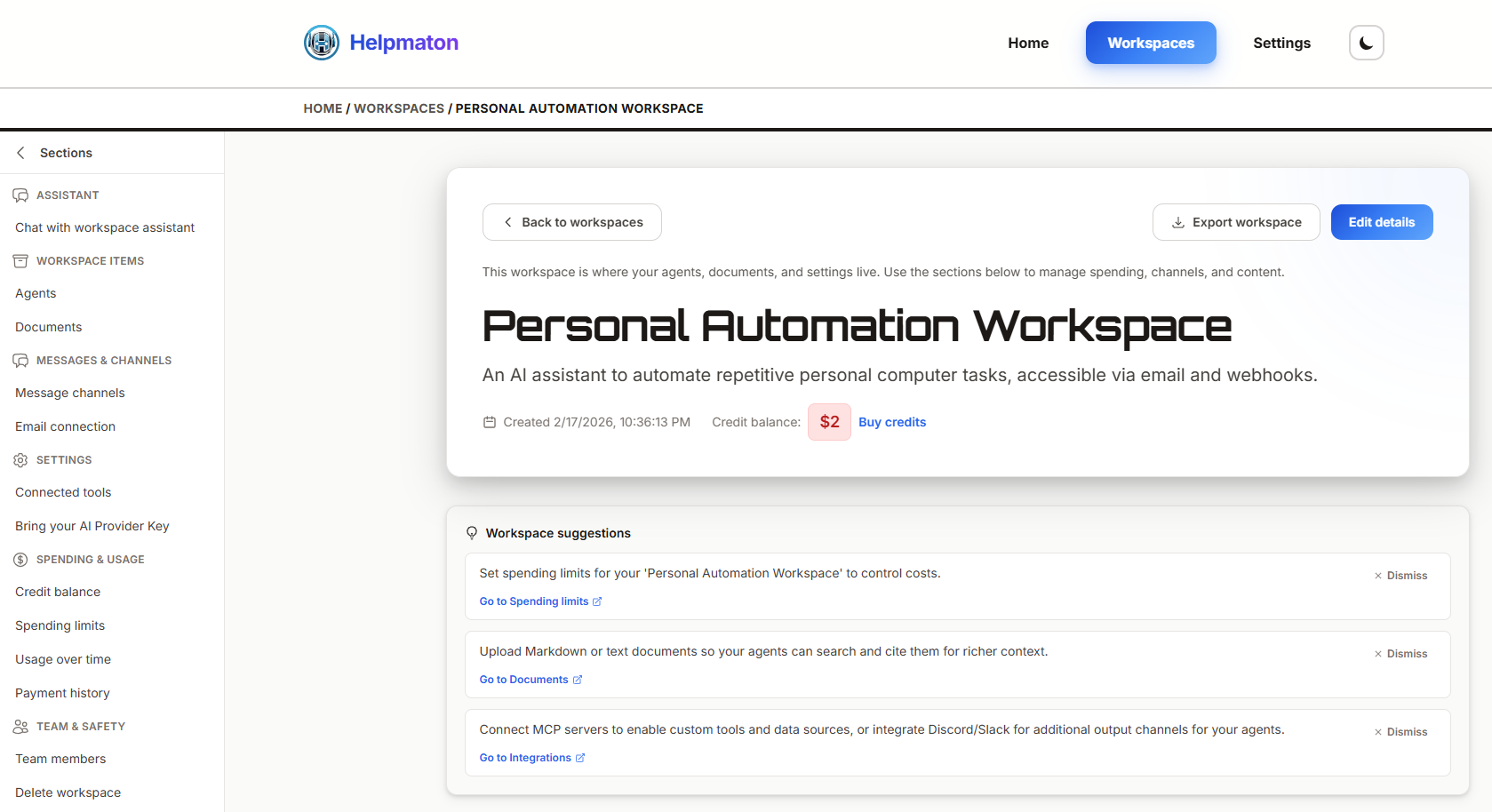
Teams deploying autonomous AI agents consistently run into the same cluster of problems. An agent fields customer inquiries — but nobody can say whether its responses are accurate. Nobody knows if the interaction cost $5 or $500 in API calls. There's no measurement system to determine if the latest version outperforms the previous one. The agent can't learn from its conversation history because every session starts with a blank slate.
The organizational response is usually risk-averse: confine agents to low-stakes, experimental scenarios. The fear of runaway costs, hallucinated outputs, and lost conversational context is so acute that deployment gets severely capped. AI remains a sideshow feature rather than graduating to operational infrastructure.
Helpmaton inverts this relationship by treating each agent as a governed entity — budgeted, monitored, measured, and integrated — rather than a raw API endpoint fired blindly into production.
The Five Problems That Block Production Agent Adoption
Every team I've observed deploying agents encounters the same obstacles:
Cost blindness: Agents run, bills accumulate, nobody tracks spending until the invoice arrives. One misconfigured loop can burn thousands overnight.
Context amnesia: Every conversation starts from zero knowledge. The agent can't reference previous exchanges or build on accumulated interaction history. Each session is a cold start.
Quality vacuum: Is the agent performing adequately? Has it degraded since the last update? Without systematic evaluation, nobody knows.
Integration friction: Connecting agents to Slack, Discord, or internal tools requires custom engineering per integration. Each takes one to two weeks of development time.
No audit trail: When an agent delivers a wrong answer or behaves unexpectedly, there's zero visibility into what happened or why.
Helpmaton addresses all five as first-class concerns.
Budget Governance: Spending With Guardrails
The platform layers financial controls at three levels:
Agent-level caps: "The customer support agent has a $50 monthly API budget." User-level caps: "This team's collective agents can't exceed $200 per month." Organization-level caps: "All agents across every department stay under $10,000 monthly."
When spending approaches a boundary, Helpmaton acts automatically: switches to cheaper model variants (GPT-4o → GPT-4o mini, Claude 3.5 Sonnet → Haiku), surfaces alerts at 75% utilization, pauses agents when hard limits trigger, and provides dashboards breaking down spend by agent, team, and time window.
During testing, a customer support agent entered an infinite reply loop with a single user. Without budget controls, the uncontrolled API calls would have exceeded $3,000. With Helpmaton, the system detected the anomalous spending signature, automatically downgraded to a cheaper model while maintaining service continuity, and alerted the team. Total incident cost: approximately $40.
This capability alone justifies adoption for any organization deploying more than three agents.
Memory Architecture: Agents That Accumulate Knowledge
Standard implementations treat each interaction as isolated. Reset after reset. No learning accumulates.
Helpmaton's memory system changes the game:
Conversation memory: Complete interaction history with each user carries across sessions. Returning customers experience continuity rather than starting over.
Long-term memory: The agent builds persistent understanding. It learns that Customer A habitually asks billing questions, prefers technical explanations, and had a specific issue resolved three months ago. This context becomes available in every subsequent encounter.
Shared organizational knowledge: Multiple agents access a common base of company FAQs, policy updates, and procedural documentation.
Automatic memory pruning: Irrelevant information gets cleaned up to manage token consumption and API costs.
Memory retrieval: Agents can search their own history. "What did we discuss with this customer last quarter?" becomes answerable.
Practical impact: a returning customer contacts support. Instead of the generic "How can I help?" the agent opens with "I see you experienced billing issues last quarter — are you following up on that, or is this a separate matter?" Resolution rates climb. Repeat customers feel recognized rather than treated as transaction numbers.
Model Context Protocol: Integration Without Custom Engineering
MCP (Model Context Protocol) is emerging as the standard for tool integration. Instead of writing custom integration code for each external system, MCP supplies a uniform interface layer.
Helpmaton's MCP support translates to:
Accelerated integration velocity: Connect any MCP-compatible tool without dedicated development. What typically consumed one to two weeks of engineering per integration shrinks to hours.
Consistent interaction model: Whether connecting Slack, GitHub, Jira, Linear, or internal APIs, the connection methodology stays the same.
Internal ecosystem enablement: Other teams can publish MCP-compatible tools, building a growing library of organizational integrations.
Zero vendor dependency: MCP is an open standard. Your integrations work across platforms, not just within Helpmaton.
During evaluation, integrating eight distinct tools (Slack, GitHub, Jira, Linear, a PostgreSQL instance, Stripe's API, an internal company wiki, and email) required about four hours total. Without MCP, the equivalent effort would have consumed three to five days.
Quality Assurance: Moving Beyond "It Seems Fine"
Helpmaton's Judge Evals system introduces rigor where most teams operate on intuition:
- Define success criteria: accuracy thresholds, tone requirements, completeness benchmarks
- Execute sample interactions against curated test cases
- AI judges evaluate outputs against defined criteria
- Generate quality reports identifying specific failure cases
A customer support agent should ideally resolve issues within three messages, maintain consistent professional tone, and leave the customer with clear next steps. Judge Evals scores this against 100 sample conversations and returns quantitative pass/fail distributions.
Teams graduate from "the agent seems okay" to structured performance metrics: 87% resolution success rate, 2.1 average messages to close, 96% professional tone adherence, 92% clear-next-step delivery, and a detailed list of specific scenarios where the agent underperformed.
This enables data-driven iteration: deploy a new version, run Judge Evals against the same test suite, compare metrics to the previous release, and promote or roll back based on evidence rather than instinct.
Multi-Agent Orchestration
Complex workflows demand coordination across multiple specialized agents:
Sequential pipelines: Agent A processes input and passes structured output to Agent B for downstream refinement.
Intelligent routing: A classifier agent inspects each incoming request and dispatches it to the appropriate specialist — billing queries to the billing agent, technical issues to the engineering support agent, general inquiries to the triage agent.
Parallel execution: Multiple agents attack different aspects of a problem simultaneously, with results synthesized at the end.
Dispute resolution: When agents produce conflicting outputs, predefined tiebreaker logic selects the path forward.
Example workflow: Customer inquiry arrives. Router agent classifies it as a billing question and forwards it to the billing specialist. Specialist attempts resolution. If confidence falls below 70%, the case escalates to a human operator with full conversation context attached. If resolved, confirmation is sent. At no point does a human handle a simple case that the agent could have closed — and at no point does an agent attempt to bluff its way through a complex case it can't handle.
Deployment Flexibility
Managed Cloud: Helpmaton hosts the infrastructure. Setup takes minutes. Zero operational burden.
Self-Hosted: Deploy on your own servers. Full data sovereignty. All processing stays within your perimeter.
Hybrid: Sensitive agents run self-hosted. Non-sensitive workloads leverage the cloud. Mixed deployment posture.
Organizations with stringent data residency requirements — healthcare, financial services, legal — gravitate toward self-hosted. Others favor the operational simplicity of managed cloud.
Integration Depth
- Slack: Agents materialize as Slack bots participating in channels with full conversational context
- Discord: Equivalent to Slack integration — agents blend naturally into server interaction patterns
- Webhooks: Custom triggers initiate agent workflows from any internal system
- Databases: Agents read from and write to databases within defined access control boundaries
- External APIs: Agents interface with CRM systems, support platforms, project management tools, and billing infrastructure
Every integration tested in production felt genuinely ready — MCP support made the difference between "technically possible" and "effortlessly available."
Pricing Structure
Starter (Free): Three agents, basic spending controls, limited memory persistence, community support.
Business ($99/month): Unlimited agents, full budget governance, complete memory architecture, priority support, custom MCP integrations.
Enterprise (Custom pricing): Self-hosted deployment option, dedicated SLAs, advanced security features, white-label capability.
Transparent pricing with no surprise charges. The cost structure reflects operational complexity rather than exploiting usage patterns.
Competitive Landscape
| Feature | Helpmaton | LangChain | OpenAI Assistants | Anthropic Workbench |
|---|---|---|---|---|
| Budget control | ✅ Yes | ❌ No | ❌ No | ❌ No |
| Persistent memory | ✅ Yes | ⚠️ Limited | ✅ Yes | ⚠️ Limited |
| MCP support | ✅ Full | ⚠️ Partial | ❌ No | ❌ No |
| Quality evaluation | ✅ Judge Evals | ❌ No | ❌ No | ❌ No |
| Multi-agent orchestration | ✅ Yes | ✅ Yes | ❌ No | ⚠️ Limited |
| Self-hosting | ✅ Available | ✅ Yes | ❌ No | ❌ No |
| Slack/Discord ready | ✅ Yes | ⚠️ Custom | ⚠️ Custom | ❌ No |
| Production-ready | ✅ Yes | ⚠️ Framework | ✅ Yes | ⚠️ Limited |
Helpmaton's advantage: purpose-built for team-operated, production-grade agent deployments with governance baked into the architecture from day one.
Operational Impact Summary
Without Helpmaton: Each agent demands custom integration (1–2 weeks). Cost visibility is nonexistent. Context resets between every conversation. Quality is unmeasured. Deployment stretches across months.
With Helpmaton: Agents deploy through a UI in hours. Spending is tracked and capped. Context persists and compounds. Quality is quantified through Judge Evals. Deployment becomes continuous — ship weekly updates with confidence.
For a team fielding five agents, the annual savings in integration engineering alone exceeds 50 hours. For larger organizations, those savings compound meaningfully.
Who Benefits Most
Multi-agent organizations: Budget governance and coordination prevent both cost explosions and operational chaos.
Compliance-sensitive teams: Every agent action is logged and auditable — critical for regulated industries.
Security-forward organizations: Self-hosting keeps sensitive data within the corporate perimeter.
Fast-moving engineering teams: MCP integration velocity dramatically outpaces custom development cycles.
Budget-conscious adopters: Spending controls defuse the single biggest fear that blocks agent adoption.
Less suitable for: Single-agent deployments (the platform is overengineered for this use case), teams not yet deploying agents at all, organizations without meaningful governance requirements.
What Works Exceptionally
- Budget controls: Transparent spending eliminates the surprise-invoice anxiety that paralyzes adoption
- Memory systems: Agents that improve through continued interaction deliver qualitatively different user experiences
- MCP framework: Integration speed is genuinely transformative compared to custom development
- Judge Evals: Systematic quality measurement replaces gut-feel assessments with actionable performance data
- Deployment optionality: Cloud versus self-hosted provides appropriate posture for any security stance
- Orchestration: Multi-agent workflows unlock automation sophistication beyond what single agents can deliver
Meaningful Limitations
- Learning curve: The platform's capability comes with corresponding complexity — not trivial to master
- MCP ecosystem maturity: Fewer pre-existing integrations than established automation platforms like Zapier
- Latency overhead: Memory management and quality checks add 200–500ms of processing overhead
- Enterprise pricing trajectory: Advanced features compound costs quickly at scale
- Overkill for simplicity: Teams deploying a single agent will find the governance layer excessive
Final Verdict
Helpmaton earns its category by recognizing that production AI agents demand the same governance discipline as any other operational infrastructure. Raw API calls are not a deployment strategy. Managed agents — budgeted, evaluated, memory-persistent, and orchestratable — represent the difference between AI as a risky experiment and AI as trusted infrastructure.
Rating: 4.5/5 stars
Delivers: Production-grade agent orchestration with genuine visibility and control. Budget systems perform reliably. Memory persistence improves agent usefulness. Quality evaluation builds organizational confidence. Deployment is refreshingly straightforward.
Constraints: Won't displace simpler single-agent setups. Full feature mastery requires learning investment. Latency-sensitive applications should factor in the processing overhead.
Ready to deploy AI agents as governed infrastructure rather than experimental toys?
👉 Start with Helpmaton and deploy your first managed production agent today.
Tags
# Helpmaton Review# AI Agent Management Platform# AI Workflow Automation# Autonomous AI Agents# AI Orchestration Tool# Multi-Agent Workspaces# Self-hosted AI agent platform for teams# Budget-controlled AI agents for business# AI agents with long-term memory and context# Slack and Discord AI agent integration# AI agent orchestration with Model Context Protocol# Model Context Protocol (MCP)# MCP integration# Automated AI evaluation and quality control# Judge Evals# AI agent review# Agent memory system# AI budget control# Agent orchestration# Workflow automation platform# AI agent platform# Source-available AI agent# Self-host AI agents# AI team collaboration# Agent management system# AI cost control# Persistent agent memory# Multi-agent platform# AI automation tools# Enterprise AI agentsSliptree Review - Professional Invoice Generator for Small Businesses and Freelancers
QuizBoost Review – The Invisible AI Study Assistant That Instantly Solves Questions on Any Learning Platform
Follow for new blogs
Subscribe to our blog
Subscribe to Newsletter
Subscribe to our newsletter to get the best products weekly.