The Nest Review - The Launch Board That Tracks Momentum
The Nest: What Happens to a Launch After Midnight

A launch day follows the same arc almost every time. Votes arrive in a burst, the product sits near the top for a day or so, traffic spikes for roughly 40 hours, and then the board moves on to the next batch. Two weeks later the same product is on page four, then off the front page entirely, and the signup curve has flattened back to where it started. Nothing about the product changed. Nothing about its revenue changed. The board simply stopped looking.
That is the part of product launch culture nobody puts in the testimonials. A launch board measures the 24 hours when everyone is watching. It says nothing about the eight weeks after, which is when startups either find a repeatable channel or quietly stop growing.
The Nest, built by Peregrine Intelligence, is aimed at exactly that gap. Its tagline is blunt about the intent: "What launched today, and what's still climbing weeks later." Launch day still counts. It just isn't the end of the story. Most of this review is about the scoring underneath, because that is where the board either works or doesn't.
What The Nest Actually Is
The Nest is a launch board. You submit a product, it goes through human review, and it appears in a public feed alongside everything else that launched. There are three views: Today, Momentum and Rising. There are two groupings: launched this month, which covers the last 30 days, and all products, which covers everything still live on the board.
Two things are free in a way that matters. Launching is free, and you do not have to put a badge on your website to be listed. Anyone who has run a startup launch on a board that required a backlink before approval will understand why that second point is worth mentioning. Badges exist if you want one, for live Momentum, a Launched on The Nest mark, or an award like first place on launch day or a top ten Momentum finish, and they link visitors back to your page. Nothing about the listing depends on using one.
The rest is a scoring system. Unlike most launch boards, where the scoring stays deliberately vague so it can be adjusted whenever, The Nest publishes its formula, its weights, its daily caps and its decay constant on a single page. All of it is worth walking through.
The Structural Problem With Launch Day Leaderboards
Every launch board has the same design flaw, and it is not a bug. It is the product. Rank by votes in a 24 hour window and you get a leaderboard that measures who had the loudest launch day audience. That is a legitimate signal for a certain kind of question. It is a terrible signal for "is this product worth paying attention to now," because it rewards the size of a mailing list on one specific Tuesday rather than anything that happened afterwards.
That model suits a single product launch. It fits badly for teams that launch product after product and want each one judged on how it runs, not only on how it opened.
The downstream effect is that founders optimize for the scoreboard. You spend the launch day in group chats asking for upvotes. You get a burst. Everyone who cares has already seen the product by hour 30, and there is no mechanism left to surface you to anyone new on day 45 when you ship the feature that actually made the product good.
The Nest ranks launch day too, which reads as a contradiction at first. It isn't. The launch day score is built from votes and follows only, and that score is never fed into anything else. The same votes and follows do move Momentum, but only on the day they are cast, not as a lump you can coast on. What changes is that launch day becomes one data point in a time series instead of the whole story.
How Launch Day Ranking Works
The formula is short enough to paste:
launch-day score = votes + 0.5 × followersFive rules sit around it, and they are more interesting than the formula.
- The launch day runs midnight to midnight Pacific time, not your local timezone.
- Accounts younger than three days get a vote weight of 0.25. A brand new account can still vote, it just cannot swing a ranking.
- Votes from vote rings or other coordinated manipulation count as zero, not discounted.
- Website visits do not count toward launch day ranking at all, on the grounds that visits need no account and are therefore the easiest number to fake.
- One account per person. Buying, trading or organizing votes, or running bots and multiple accounts, gets those votes excluded and can get the launch removed outright.
Paid boosts never touch launch day ranking. That is stated plainly and it is the right call, because a launch day result that could be bought would make the whole board meaningless.
One detail matters more than it first appears: voting never closes. You can upvote a product on any day it is on The Nest, not just its launch day. Each vote feeds Momentum on the day you cast it rather than retroactively boosting the launch. So a founder who keeps collecting interest for two months is not throwing those votes away, they are feeding the long term curve.
Momentum: The Number That Does Not Reset
This is the core of the product, and the reason it is worth writing about at all.
Momentum is recalculated every night for every product that has launched. It is a 7 day half-life score, which in practice means yesterday's Momentum is multiplied by 0.906 before today's activity is added. Old heat fades by roughly 9.4 percent a day. A product that stops doing anything drifts back toward zero on its own, without anyone having to decide it is over.
Here is the published formula:
activity = √(votes + 2 × follows + 0.25 × visits + 5 × updated) + traction + boost

momentum today = momentum yesterday × 0.906 + activity today
The square root is the clever part and it is easy to miss. Because the activity total is square rooted before it is added, a huge launch day cannot bury everything that comes after it. 400 votes in one day does not produce a 400 point foundation that smaller products can never catch. It produces something in the low 20s, which decays in a few weeks if nothing follows.
The daily weights:
| Signal | Weight | Notes |
|---|---|---|
| Votes | 1 | Counted on the day of first vote. Un-voting and re-voting does not double count. |
| New followers | 2 | Someone asking to keep hearing about the product. |
| Website visits | 0.25 | Unique visitors that day. |
| Maker updates | 5 | Maximum one per day, however many you post. |
| Verified traction | up to +6 | Read from connected tools, capped by source. |
| Paid boost | 6 a day on average | About 12 on the first day tapering to near 0 on the last. Added after the square root. |
Maker updates carrying a weight of 5 is an unusual design decision. Posting a real update is worth five votes, every day, and it is capped at one per day so nobody can spam their way up. In effect the board pays you to keep shipping in public rather than to keep asking for upvotes.
The site's own worked example makes the trade-off concrete, and the numbers are worth quoting because the gap is wider than the formula suggests. One product gets 400 launch day votes and then goes quiet. Another gets 90 launch day votes, adds some daily follows and visits, and posts an update every five days. At day 21 the loud launch sits at a Momentum of 7, down 48 percent on the week before. The smaller launch sits at 60, up 30 percent. A quarter of the launch day, almost nine times the Momentum three weeks later.
Both curves are drawn to their own scale, which the documentation says plainly, so the shapes are not comparable. The scores are.
One caveat the page states about itself: the method may be improved over time, and when it is, that page changes with it. So treat these numbers as a description of the board in October 2026 rather than a permanent constitution. Published and changeable beats unpublished and changeable, but it is still changeable.
Verified Traction: Stripe and GitHub That You Cannot Type In
The pitch is that real traction should count, not just attention on the board. That is easy to say and hard to build, so the parts worth checking are the caps and the permissions rather than the wording.
Makers connect tools they already run their business on by signing in. The Nest only reads. Each night it pulls that day's numbers and adds a small, capped number of points.
| Source | What counts | Daily cap |
|---|---|---|
| Stripe (revenue) | 2 × √(new customers) | 4 |
| GitHub (shipping) | 1.5 per release + 0.5 × √(commits) + 0.5 × √(new stars) | 3 |
| All sources combined, including outside signals | not applicable | 6 |
Three details here do most of the work, and they are the three that most products get wrong:
You cannot self-report. The figures are read from your own accounts. There is no field where you type in your MRR, which means the badge on the board means something.
Missing is not zero. A product with nothing connected is not penalized. Traction only adds. This is the difference between an incentive and a tax, and it is why a two week old project with no Stripe account can still compete on the board.
Revenue is shown as a range. You will see something like $1k to 10k a month, converted to US dollars, never an exact figure. For founders who are uncomfortable publishing numbers, that is a workable middle ground between hiding everything and opening the books.
You control visibility per source. A hidden source still counts toward Momentum, so you are not penalized for keeping your revenue private, and disconnecting stops the scoring immediately. More sources are on the roadmap: demand from Calendly, HubSpot, Typeform and Eventbrite, audience from Mailchimp, Kit, Slack and Bluesky, traffic from Google Search Console and Google Analytics. Treat that roadmap as intent rather than a schedule, since no dates are published.
Outside Signals: Matched by URL, Not by Name
This is the section most launch boards do not attempt. The Nest reads public signals from each product's own website, and the maker does not connect anything.
| Signal | How it counts | Checked |
|---|---|---|
| Hacker News | 0.5 per post linking to the site + 0.25 × √(its score) + 0.2 × √(comments to the site) | Nightly |
| Bluesky | 0.5 × √(number of people linking to the site) | Nightly |
| News | 0.3 × √(articles mentioning the site in the past week), applied to every day of the week | Weekly |
| Authority (Ahrefs) | Growth in referring domains, up to 0.5 per day for the month | Monthly |
| Search (Google, US) | Growth in organic keywords, up to 0.5 per day for the month | Monthly |
The caps stack in a specific order: mentions are capped at 2 points a day, search signals at 1 point a day, all outside signals together at 3 points a day, and everything outside The Nest including connected tools at 6 points a day. One rule is easy to miss: a product's own pages do not count as news about it, so your own blog post cannot become a press mention.
Two decisions in that table matter more than the rest.
Matching is by website URL, never by product name. A product called Linear cannot accidentally collect mentions meant for somebody else's Linear. If you have ever watched a same-named product absorb your press coverage, you know why this is the correct technical decision.
It measures growth, not size. An established site cannot outrank a new one by virtue of being large. Domain Rating is displayed as background context, but only new referring domains score. Search is measured as keyword growth, not keyword count. This is the single clearest statement of intent on the whole site: a two week old startup is not competing with a ten year old incumbent on accumulated authority.
There is one honest limitation built in. Products using a shared platform address, something like name.lovable.app, can earn mention signals but not authority or search signals, because those metrics describe the platform rather than the product.
Paid Boosts, Always Labeled
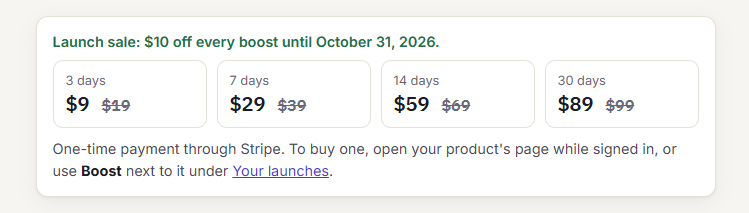
The Nest sells boosts, and it is unusually direct about how they work and what they cost, which makes them easier to judge.
Boosts come in 3, 7, 14 and 30 day lengths. The value is 6 points per boost day, added after the square root, so the same boost is worth the same to a large product and a small one. The site gives a conversion for scale: on a day with no other activity, 6 points is roughly equivalent to 36 votes.
The delivery is not flat. A boost opens at about 12 points on day one, declines evenly each day, and lands near zero at the end. Because everything decays on the same 7 day half-life, the resulting Momentum curve looks like an arrow: a fast climb, a peak around the middle, then a smooth slide with no cliff at the end. The documentation gives a worked example, a 30 day boost with no other activity peaking near 68 around day 14.
The guardrails matter more than the points:
- Boosts affect the Momentum and Rising views. They never affect launch day ranking.
- Products are labeled Boosted during the boost and for 14 days afterwards, on both the board and the product page.
- On the product page, boosted days are shaded, and the daily breakdown separates boost from votes, follows and visits, so paid and organic growth are visually distinct.
- Only the maker can buy a boost, one at a time, only while the launch is live.
- Cooldown is equal to the boost length. A 7 day boost is followed by 7 days off. The site's phrasing is direct: nobody can buy their way to a permanent top spot.
- Boosts the platform gives away, like the ones handed to the first launches on the board, carry exactly the same label as paid ones.
Pricing is published, which is rarer than it should be. Plenty of boards keep boost costs behind a sales conversation, which makes the tiers hard to compare:
| Length | Sale price | Standard |
|---|---|---|
| 3 days | $9 | $19 |
| 7 days | $29 | $39 |
| 14 days | $59 | $69 |
| 30 days | $89 | $99 |
The site is running a launch sale with $10 off every boost until October 31, 2026, and the left column is the discounted price. Payment is a one time Stripe charge, either from your product's page while signed in or from the Boost button next to your launch under Your launches.
Do the arithmetic on the 30 day option and it works out to about $3 a day for 180 Momentum points. Since 6 points is what 36 votes adds on an otherwise quiet day, the whole boost buys roughly what 1,080 votes would have bought, spread evenly across the month. That is cheap for a month of visible presence and wasted money if you buy it and then ship nothing, because a boost only props up the curve. It does not create followers, visits or updates.
Three Views, One Board
The board splits into three views, and the split is not cosmetic.
Today is the launch day feed. Votes plus half of follows, midnight to midnight Pacific.
Momentum is the long term ranking, ordered by the score and recalculated nightly. Everything still active is on it.
Rising is ranked by change, not by total. The ▲ and ▼ numbers compare today's Momentum with Momentum from 7 days ago. Products with less than 8 days of history show New, and so do products whose score a week ago was too small for a percentage to mean anything.
Rising is the most useful of the three. A product with a modest absolute score and a strong 7 day climb is the most interesting thing on any launch board, and almost no other board surfaces it as a first class view.
Chart reading is documented in a way that saves confusion later. A hollow dot marks the launch day where the line begins, the line itself is daily Momentum since then, and a filled dot is today. On a product page, diamonds mark days the maker posted an update and shaded bands mark paid boost days. Sparklines cover the last 30 days and are scaled to each product's own range, so they communicate shape only. Compare products by the Momentum number and the 7 day change, not by curve height.
There is a line style detail that turns out to be an honesty feature. A solid line means every signal was measured by The Nest itself. A dashed line means that day includes self reported data. As of writing every signal is measured on the board, so every line is solid, but the mechanism exists for the day a maker-supplied number arrives, and it tells you which days to trust less.
The Weaknesses Section Is Locked, and That Is the Point
This is the strangest feature on the product, and the most interesting one.
When you submit a product, Fill with AI reads your website and drafts the profile: name, tagline, description, features, strengths, weaknesses, tags and categories. Everything is editable except the weaknesses.
The reasoning given is that a cautious buyer wants to know the limitations and open questions, and the AI is reading both what your site says and what it does not say. A missing pricing page becomes a documented weakness. The maker cannot edit or delete it, and re-running the AI on the same page produces the same analysis.
If something in there is factually wrong, you can appeal from the product page, and every appeal is reviewed by a human who decides whether to remove, correct or keep it. If a maker skips the AI drafting step, The Nest runs it at review time anyway, so every product on the board gets treated the same way.
Strengths and weaknesses do not affect ranking or Momentum. They exist to help a reader decide. In practice this means the board publishes a short list of caveats about your product, written by a model, that you cannot touch. Founders will hate this for about a week. It is also the reason a listing there reads like a review rather than a press release, which is more valuable for a startup launch than another five star badge.
Submitting a Product, Step by Step
The flow is short.
- Submit a product from the board and let Fill with AI draft the profile from your website, or write it yourself.
- Correct anything except the weaknesses, set your tags and category.
- Go through human review. The site states that every approved launch links to the maker's site with a normal link because of this review step, and that links are marked sponsored while a boost is running.
- After approval, decide which traction sources to connect. Stripe and GitHub are live. Every source has its own public visibility toggle.
- Post an update when you ship something. It is worth 5 points, once a day, and it is the cheapest thing on the list.
- Watch the 7 day change rather than the absolute number for the first two weeks, since the absolute number is still mostly launch day residue at that point.
If you are launching several things, the practical advice is to stagger them. Launch day score is per launch day, but Momentum is per product, and there is no benefit to running two launches into the same audience on the same afternoon.
What Works and What Does Not
Here is the split, read from a founder's side rather than a growth marketer's.
Works well
- The published formula. Every weight, cap and decay constant is on one page, which means the ranking can be audited instead of taken on faith.
- The square root and the half-life together. A launch board that mathematically cannot be dominated by a single big day is a different product from the one everyone is used to.
- Verified traction with real caps. Stripe and GitHub read directly, ranges instead of exact revenue, missing counted as nothing rather than zero.
- Growth-based outside signals. Matching by URL and scoring new referring domains instead of total authority is the right way to give a new startup a fair shot.
- Boost transparency. Prices on the page instead of behind a call, label during and after, shaded chart bands, separate line items, cooldown, and identical treatment for free boosts.
- Launch day ranking that cannot be bought.
Where it is thin
- A 30 day boost peaks around day 14 and then glides down, so the last two weeks mostly slow the decay rather than add reach. The $89 buys presence for a month, not a month of climbing.
- Two live integrations. Stripe and GitHub cover a lot of software businesses, but a services-heavy or marketplace startup may find little to connect today. The rest is roadmap.
- Outside signals lean on Ahrefs and Google US data, which quietly favors products with an English language, US-facing web presence.
- The board is new, so the sample data warning on the front page is real. Traffic from the Momentum views depends on an audience that has not built up yet.
- Momentum decay is unforgiving by design. Take three weeks off from shipping and posting, and the curve says so in public.
- Locked weaknesses will be a dealbreaker for some founders, whatever the appeal process says.
Who Should Launch Here
Most founders arrive with the same sentence in their head: launch my idea somewhere that is still paying attention in six weeks, not somewhere that crowns a winner at midnight and clears the table by morning. That is the case this board is built for.
The Nest fits startup founders who want exposure past launch day and are willing to keep a public record of what they are shipping. If you can connect Stripe or GitHub and you post an update at least weekly, the mechanics are on your side, because both of those are weighted to reward consistency rather than one big push.
It suits indie makers and small SaaS teams who find the launch day scramble distasteful and would rather be judged on a month of shipping. It also suits products with a Hacker News or Bluesky footprint, since those mentions are read automatically with nothing to set up.
It is a weaker fit if you need volume today and nothing else, if your traction lives somewhere other than Stripe or GitHub, or if you cannot accept a machine-written weaknesses list on your public page. And if you are launching purely to get a permanent backlink, note that badges are optional and links are ordinary, but the value here is attention, not link equity.
The Nest Review Verdict
Most launch boards are contests. The Nest is closer to a leaderboard for a sport with a long season. Launch day gets you on the board, then the daily scoring decides whether anyone still sees you in week six, and the reason that works is not marketing language, it is a decay constant and a square root.
For startups that ship every week, that is a better deal than a spike. The score moves when you do something, which sounds obvious until you compare it with every board where the score moved once, on a Tuesday, and then froze.
What deserves the most credit is that the scoring design is adversarial towards its own customers. Boosts cannot buy launch day rank. Revenue can only appear as a range. Weaknesses cannot be edited. Big incumbents cannot win on accumulated authority. Every one of those choices costs the platform some revenue or some goodwill from the founders it depends on, and every one of them makes the list worth reading. For a startup launch, a board that is hard to game is worth more than a board that is easy to top.
What holds it back is maturity, not design. Two integrations, a boost price list that goes back up by $10 a slot when the launch sale ends on October 31, 2026, and an audience still forming. Those are the problems of a product that shipped early and said so, which is exactly what the board claims to reward.
Rating: 4.4/5
Delivers: a fully documented scoring model, a launch ranking that cannot be purchased, verified traction that is read rather than typed, outside signals measured as growth instead of size, and boost labeling that survives a close look.
Growth areas: the integration list is short for now, boost prices are on a sale that ends October 31, 2026, and the locked weaknesses section will cost it some founders.
If you have a product ready and you are tired of the 24 hour scoreboard, the honest next step is to test the mechanics on your own launch rather than trust a write-up.
👉 Launch your product now on The Nest and watch what your Momentum looks like three weeks after launch day, which is the only number that tells you anything.
Tags
# Review# The Nest review# The Nest# Peregrine Intelligence# Product launch# Launch board# Startup launch# Startups# Launch product# Launch my idea# Product launch platform# Launch day ranking# Momentum score# 7-day half-life score# Verified traction# Stripe revenue signal# GitHub shipping signal# Hacker News mentions# Bluesky mentions# AI drafted product profile# Honest product weaknesses# Launch day leaderboard# Launch a startup for free# Indie maker launch# SaaS launch platform# How to get early users# Product discovery board# Boosted label transparency# Launch day votes# Maker updatesFollow for new blogs
Subscribe to our blog
Subscribe to Newsletter
Subscribe to our newsletter to get the best products weekly.