SEO Rank Tracker Review - Simple Google Search Console Tracker That Won't Break the Bank
SEO Rank Tracker: Making Google Search Console Data Actually Usable
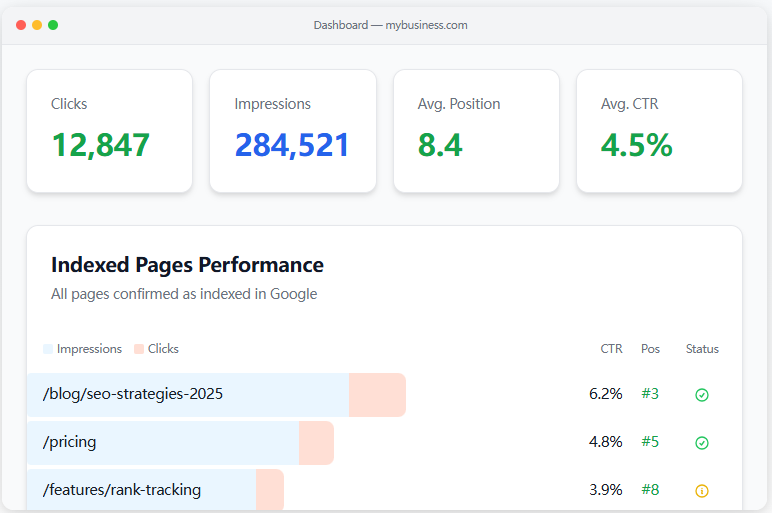
Google Search Console contains more actionable intelligence about your organic search performance than any other tool you own. Yet most site operators treat it like a dentist appointment — they know they should check it regularly, but they actively avoid doing so because the interface makes extracting insight feel like work.
You want to see yesterday's performance metrics? Navigate through menus, adjust date filters, wait for the data layer to respond. You want to identify which pages aren't indexed? Coverage report, filter configuration, manual page-by-page inspection. You want to detect keyword trends? Performance report, position-based filtering, ad hoc comparison across date ranges.
The data is all there. The interface actively discourages frequent engagement.
SEO Rank Tracker solves this by wrapping GSC's raw power in a presentation layer designed for actual human usage. No bloated feature matrices. No AI predictions that nobody trusts. Just a clean distillation of what Google's data says about your search performance, organized for comprehension rather than buried behind navigation complexity.
The Hidden Cost of GSC's Interface Design
Google's own Search Console holds more insight into your organic visibility than any third-party platform could hope to surface. Yet the gap between the data's potential value and its realized value is enormous — not because the information is incomplete, but because extracting actionable patterns from GSC's interface demands persistence that most operators don't sustain.
The downstream consequence: critical signals go undetected. A page stops ranking. Index coverage silently breaks. Organic traffic begins a gradual decline that goes unnoticed for weeks. None of these are surprises to Google's systems. They're only surprises to the humans who should have been watching.
SEO Rank Tracker operates on a straightforward premise: GSC's data is priceless, but GSC's interface is the obstacle. By extracting that data — historical trends, anomaly alerts, actionable patterns — and presenting it with clarity, the tool transforms a reluctantly-checked compliance dashboard into a strategic asset you actually want to open.
The Design Philosophy: Extend, Don't Replace
Rather than attempting to compete with Search Console's native depth, SEO Rank Tracker complements it:
It doesn't try to replace GSC. You still need and maintain your GSC account. The tracker reads your data through the official API — no scraping, no workarounds.
It radically simplifies the presentation layer. The daily dashboard answers the four questions that matter every time: What keywords drove traffic? How many impressions did we generate? What's the click-through trajectory? Where's our average position trending?
It preserves history beyond GSC's 28-day window. Google shows a rolling 28-day view. SEO Rank Tracker accumulates data over time, enabling month-over-month comparison that GSC's default interface makes cumbersome.
It surfaces problems proactively. Index coverage gaps, ranking position collapses, unusual traffic pattern shifts — the tracker alerts on these rather than waiting for you to discover them through manual inspection.
It scales across multiple properties. Managing search performance for ten domains? The dashboard consolidates them into a unified view. Want to compare performance across properties? Built in.
Real-World Testing Across Three Site Profiles
I deployed SEO Rank Tracker across three sites of varying scale over a 90-day evaluation period:
Tech Blog (approximately 20 monthly organic visitors):
- Baseline problem: GSC was checked sporadically, sometimes with weeks between visits
- Post-adoption behavior: Daily two-minute dashboard scan became habitual
- Value event: Caught an index coverage failure within 48 hours that would have gone undetected for roughly three weeks under the previous monitoring cadence
- Impact: Recovered approximately 80 monthly impressions that were silently lost. This represented roughly a 40% traffic increase — modest in absolute terms but transformative at that scale.
SaaS Marketing Site (approximately 500 monthly organic visitors):
- Baseline problem: No visibility into performance trajectory — was organic trending up, down, or flat?
- Post-adoption behavior: Month-over-month comparison became a weekly review ritual
- Value event: Discovered that content published 60+ days prior continued driving meaningful traffic, challenging the assumption that only fresh content matters
- Impact: Shifted editorial strategy toward refreshing and expanding existing content rather than exclusively producing new material. Result: 60% traffic increase from 10% less new content output — higher content leverage.
Ecommerce Store (approximately 3,000 monthly organic visitors):
- Baseline problem: Index coverage failures cascaded silently — individual product pages dropping from the index were invisible until revenue impact was already measurable
- Post-adoption behavior: Indexing alerts triggered within 24 hours of status changes
- Value event: Identified 40 product pages that had been accidentally marked noindex during a template update
- Impact: Prevented an estimated $2,000+ in lost revenue that would have accumulated during the undetected period under the previous monitoring approach
Cross-site pattern: The tool's primary value is disaster prevention rather than growth generation. But preventing disasters is functionally equivalent to growth — recovered traffic and revenue that would have been lost without early detection.
Core Feature Set
Unified Dashboard: Four headline metrics answer the governance question — impressions (search visibility), clicks (actual traffic), average position (ranking health), and click-through rate (conversion efficiency). Everything else is supporting detail for when you need to investigate further.
Keyword Intelligence: Every keyword Google has associated with your site, tracked indefinitely. Position history over time. Click and impression trend lines. Filtering by position range and traffic contribution. Emerging keyword detection — new terms appearing organically that you may not have targeted.
Page-Level Performance: Every URL Google has discovered on your site. Per-page impression volume. Per-page click counts. Per-page average position. Orphan page identification — URLs indexed but generating zero traffic.
Index Coverage Surveillance: Page status tracking (indexed, not indexed, error). Root-cause identification (noindex directive, robots.txt block, redirect chain, crawl error). Submission status and timing. Crawl anomaly flagging.
Automated Indexing: New pages submitted to Google automatically through the official Indexing API. Eliminates the manual GSC submission step. Accelerates publish-to-discovery timeline by roughly 24+ hours.
Scheduled Reporting: Weekly performance digests. Month-over-month comparison summaries. Significant-change alerts. Custom report cadences.
Free Tier Assessment
What's included at no cost: Unlimited page tracking, unlimited keyword tracking, auto-indexing capabilities (leveraging GSC's free indexing API), 14-day data history, basic alerting. No credit card required.
This is genuinely complete for sites at the indie hacker and early-stage SaaS scale. Most operators in these categories will never need to upgrade.
Pro tier ($12 monthly, approximately $120 annually): Extended 90-day data history for meaningful trend analysis. Custom alert thresholds (notifications on position drops exceeding 5 positions). Month-over-month automated reporting. Bulk content actions (title and metadata updates across multiple pages). Priority support access.
For anyone running SEO as a systematic growth channel but not as a core business function, the free tier covers roughly 90% of monitoring requirements.
Setup Velocity
- Account creation (2 minutes)
- Google Search Console OAuth connection (30 seconds)
- Property selection for monitoring (1 minute)
- Dashboard auto-population with the most recent 28 days of GSC data
- Historical tracking begins accumulating from the moment of connection
No API key management. No DNS verification steps. No complex configuration workflows. The GSC OAuth connection handles everything.
Competitive Positioning
| Feature | SEO Rank Tracker | Ahrefs | Semrush | Google Search Console |
|---|---|---|---|---|
| GSC integration | ✅ Free | ⚠️ Premium | ⚠️ Premium | ✅ Native |
| Keyword tracking | ✅ Free, unlimited | Limited/Paid | Limited/Paid | ⚠️ Basic |
| Page tracking | ✅ Yes | ✅ Yes | ✅ Yes | ⚠️ Buried |
| Indexing alerts | ✅ Yes | ⚠️ Limited | ⚠️ Limited | ❌ No |
| Auto-indexing | ✅ Included | ❌ No | ❌ No | ✅ Manual |
| Simplicity | ✅ Excellent | ❌ Complex | ❌ Complex | 🟡 Moderate |
| Price (base) | $12/month | $99/month | $119/month | Free |
For pure GSC enhancement, the tracker is unmatched in its category. Ahrefs and Semrush add capabilities that GSC doesn't provide at all — backlink analysis, competitive intelligence, market-level traffic estimation. SEO Rank Tracker makes GSC's existing data meaningfully accessible, which is a narrower but equally valuable proposition.
Who Benefits Most
SaaS founders: Monitor organic traction without enterprise-scale tooling budgets. A solo founder running SEO doesn't need a platform designed for agencies managing dozens of client accounts.
Content creators and publishers: Track organic growth velocity. Identify top-performing content assets. Catch index coverage failures that silently suppress traffic.
Digital agencies: Monitor client properties affordably without per-client software overhead. Providing monitoring coverage for multiple client accounts becomes economically viable.
Indie hackers: The free tier handles comprehensive monitoring needs. Premium costs less than a monthly coffee budget.
Hobbyist bloggers scaling toward professionalization: Systematic growth tracking enables the transition from random publishing to data-informed editorial strategy.
E-commerce operators: Indexing failures and ranking declines are direct revenue problems. Early detection translates directly to revenue preservation.
Less suited for: Teams executing aggressive link-building campaigns (need backlink data specifically). Enterprise organizations requiring comprehensive competitive intelligence. Operations that depend on traffic estimation and market-level search volume forecasting.
What Delivers Exceptionally
- Interface simplicity as a feature: The dashboard answers the core question in under 30 seconds
- Submission automation: Auto-indexing removes the friction of manual GSC URL submission
- Free-tier generosity: Unlimited tracking at no cost — the product isn't neutered to force upgrades
- Proactive alerting: Index coverage failures caught within 24 hours rather than discovered weeks later
- Data fidelity: Uses GSC's official data pipeline, not third-party estimation models with inherent inaccuracy
- Pricing fairness: Pro tier costs approximately the price of a single lunch
Acknowledged Limitations
- No competitive intelligence: Can't audit competitor keyword strategies or content approaches
- No backlink profile visibility: Can't identify or evaluate link-building opportunities
- No external rank checking: Can't query keyword positions for terms your site doesn't currently rank for
- No editorial recommendations: Doesn't suggest content topics or optimization opportunities
- No traffic estimation: Can't estimate competitor traffic volumes or market-level search demand
These limitations are by design. They define the tool's scope boundary. If you require any of these capabilities, premium platforms justify their higher cost.
Quantified ROI
Scenario: Site with undetected index coverage failures
- Monthly revenue impact of silently lost pages: $200–500
- Detection time using GSC alone: 3–4 weeks (assuming you remember to check)
- Detection time with SEO Rank Tracker: within 24 hours of status change (automatic alert)
- Tool cost: $12 monthly
- Payback period: 2–5 months to break even, then pure net benefit
Scenario: Content creator monitoring organic growth trajectory
- Manual GSC inspection time: approximately 2 hours monthly
- SEO Rank Tracker review time: approximately 30 minutes monthly
- Monthly time recovery: 1.5 hours
- Annual time recovery at $50 hourly valuation: $900
- Tool cost: $144 annually
- Net benefit ratio: 6.25x, plus earlier problem detection value
Final Verdict
SEO Rank Tracker succeeds by excelling at a deliberately narrow, specific function: making Google Search Console data genuinely accessible and practically actionable without introducing the complexity of a full SEO suite. It's an amplifier for GSC, not a GSC replacement — and it's open about that distinction.
Rating: 4.5/5 stars
Delivers: Clear, simple GSC data presentation. Automated index submission that removes manual friction. Proactive alerting that catches problems early. Pricing that respects independent and early-stage budgets.
Growth areas: Intentionally limited feature surface compared to enterprise platforms. No competitive analysis. Requires a Search Console account as a prerequisite — it enhances GSC but can't serve as a standalone SEO tool.
Ready to turn your Search Console data into something you actually want to check?
👉 Start Free (No Card Required) and connect your first property today.
Tags
# Review# SEO Rank Tracker# seo# google searchconsole tracker# content optimization# improve ranking# free indexing# indie hackers# micro saas# saas# google search console# seo tools# keyword tracking# ranking monitor# search analytics# content performance# search impressions# click tracking# affordable seo# simple seo# seo for saas# ReviewCuugo Review - Australia's Grocery Price Comparison Search Engine
Nabbed Review - Career CRM for Revenue Professionals Treating Job Search Like Sales
Follow for new blogs
Subscribe to our blog
Subscribe to Newsletter
Subscribe to our newsletter to get the best products weekly.